What Happens to Your Sound When You're Always in Someone Else's Room
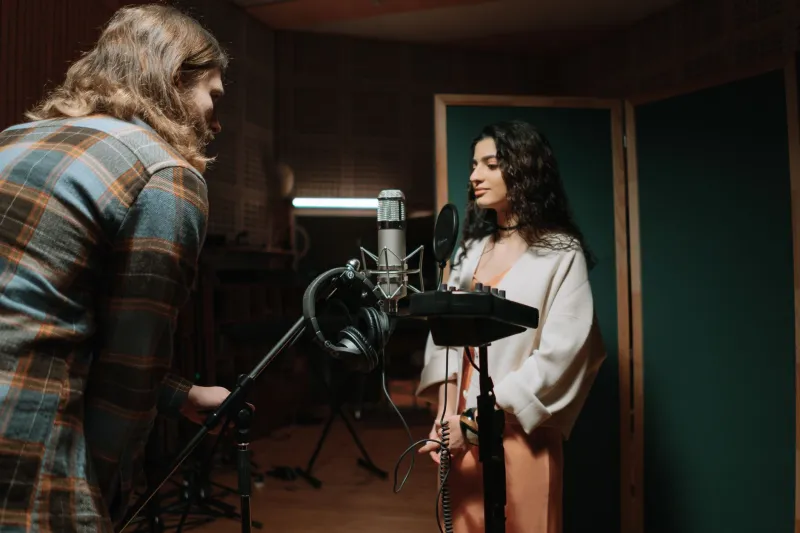
There's a version of me from about three years ago who said yes to every collaboration that knocked on her door. A producer wanted to co-write? Yes. A visual artist wanted to fold my music into their installation? Absolutely. A fellow creator wanted to build a whole project together from scratch? Let's go.
I thought I was growing. And in some ways, I was. But somewhere in all that saying yes, something started to slip. When I went back to work alone — really alone, just me and a blank page or an empty session — I kept second-guessing choices I would have made on instinct six months earlier. The collaborations had left a residue. Not all of it bad, but some of it quietly, persistently not mine.
I started calling it the collaboration tax. The creative cost you pay that nobody warns you about when they're telling you how amazing it is to work with other people.
You Don't Always Know It's Happening
The tricky thing about losing your voice through collaboration is that it doesn't feel like loss in the moment. It feels like compromise, which feels like maturity, which feels like growth. You're learning to let go of being precious. You're becoming a better team player. You're expanding your range.
Except sometimes you're not expanding. Sometimes you're just... accommodating. And there's a real difference.
Expanding your range means you can do more things. Accommodating means you're doing fewer of the things that are actually yours. One adds to you. The other subtracts from you slowly enough that you don't notice until you're sitting alone in a room wondering why everything you make sounds like it was made by committee.
I've watched this happen to artists I admire, too. They start out with this unmistakable thing — a specific texture, a specific emotional frequency — and then they spend a few years in back-to-back collaborations and the thing gets... diluted. They're still talented. The work is still good. But the them in it got quieter.
The Problem With Being a Good Collaborator
Here's the paradox: the better you are at collaborating, the more at risk you are.
Good collaborators listen. They adapt. They read what the project needs and they give it that, even when it means pulling back on their own instincts. Those are genuinely great skills. But if you're always doing that — if every creative relationship you're in asks you to be adaptive and flexible and accommodating — then your own instincts can start to atrophy from disuse.
It's like a muscle. If you only ever use it in service of someone else's workout, it gets conditioned to support, not to lead.
I had a collaborator once who was incredibly strong creatively. Dominant in the best way — clear about what they wanted, decisive, confident. Working with them was exciting. It was also, I realized later, a full takeover of the project's identity. My fingerprints were on the work, but my voice wasn't. And because the project was genuinely good, I didn't question it. I just called it a win and moved on.
Several projects like that in a row, and I had a portfolio full of wins that didn't sound like me.
What 'Your Sound' Actually Means
I think we throw around the phrase 'finding your voice' without being specific enough about what that actually is. Because your voice isn't just a style. It's not an aesthetic or a genre or a set of technical choices. It's closer to a perspective — a particular way of seeing and translating the world that shows up in everything you make, regardless of the medium.
For me, that perspective has something to do with emotional specificity. With finding the exact word or note that names a feeling instead of gesturing toward it. With a certain intimacy, like I'm talking directly to one person rather than performing for a crowd.
When I'm in a collaboration that honors that, the work gets better. When I'm in one that doesn't — when the project pulls toward the broad and the crowd-pleasing and the safe — the work gets blurry. Technically competent. Emotionally imprecise. Not mine.
Knowing what your voice actually is — getting specific about it — is what lets you protect it. You can't protect something you haven't named.
How to Collaborate Without Disappearing
I'm not arguing against collaboration. I'm arguing for going into it with your eyes open.
Some things that have helped me:
Do solo work in between. Not as a palate cleanser — as a practice. Make something completely alone, with no input, no feedback, no collaboration before you release it or even share it. Keep the solo muscle active.
Name your non-negotiables before you start. Every collaboration has things you're willing to bend on and things you're not. Know which is which before you're in the room and the momentum of the project is making every compromise feel reasonable.
Notice when you're accommodating versus expanding. Ask yourself honestly: is this choice adding something to my range, or am I just making it to keep the peace? Both happen. But you should know which one you're doing.
Give yourself a re-entry project. After a big collaboration ends, make something just for you before you take on the next one. It's a way of checking in — of asking yourself what's still there, what got influenced in ways you want to keep, and what you want to walk back.
The Tax Isn't Always a Bad Thing
I want to be honest about this: some of what I picked up from collaborations I didn't want to give back. Certain instincts got sharper. Certain blind spots got named. I learned things about my own voice by hearing it in contrast to someone else's.
The collaboration tax is real, but it's not always a rip-off. Sometimes you're paying for something genuinely valuable.
The point isn't to stop collaborating. It's to be a conscious spender. To know what you're paying, what you're getting, and whether the exchange is actually worth it — not just in terms of the project's outcome, but in terms of what it does to the artist you're becoming.
Your voice took a long time to develop. It's worth protecting with at least as much intentionality as you bring to the work itself.