The Part of Making Art Nobody Puts in the Caption

Let me tell you what my Tuesday actually looked like.
I spent forty minutes updating a tracking spreadsheet for pitches I'd sent out. I wrote three follow-up emails to people who hadn't responded, reread them four times each, and still felt weird hitting send. I declined a collaboration that wasn't right for where I'm headed, which required a careful, kind email I rewrote twice. I updated my press bio because the old one was two years out of date and I'd been putting it off for months. I responded to a licensing inquiry, looked up what the going rate was, second-guessed myself, and responded again.
At no point during any of this was I making art.
Except — and this is the part I want to talk about — in every way that actually matters, I absolutely was.
The Myth We Keep Telling Ourselves
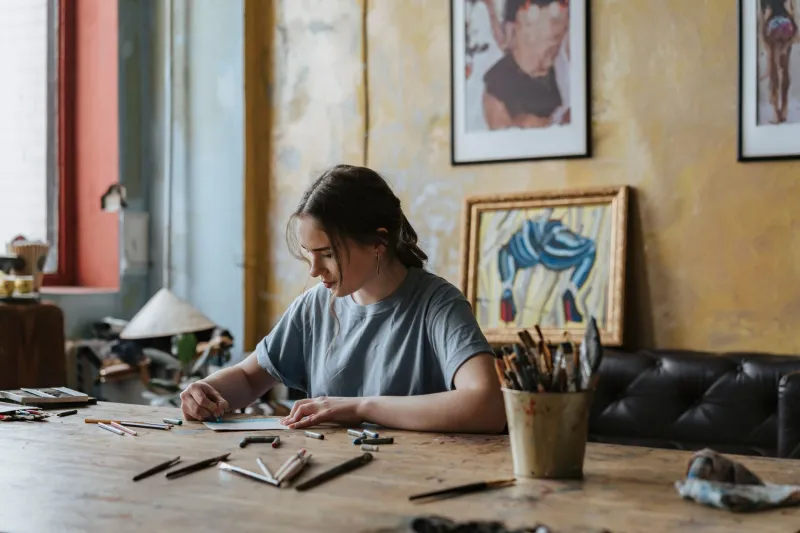
There's a version of the creative life that gets celebrated constantly, and it looks like this: the artist, alone, in a beautiful chaotic space, struck by inspiration, making things. That's the image on the mood board. That's the story in the interview. That's what the caption says.
What the caption doesn't say is that the artist also spent two hours that week negotiating a contract, one hour on hold with a venue, thirty minutes trying to figure out why their invoice hadn't been paid, and an entire afternoon updating their website because it still had a show listed from eight months ago.
We've collectively decided that this second category of work isn't real creative work. It's overhead. It's the unfortunate price of doing business. It's what you do so you can get back to the actual art.
I used to believe that too. And it made me miserable, because I spent half my working hours feeling like I was failing at being an artist — like I was wasting time I should have been spending creating.
What Changes When You Reclassify the Work
At some point I started an experiment. Instead of treating admin, outreach, and logistics as the enemy of my creative practice, I started treating them as part of it. Not glamorous parts. Not the parts I'd highlight in an interview. But legitimate, necessary, craft-adjacent parts.
Here's what shifted: the resentment went down. A lot.
When I was writing a pitch email and thinking I should be making something right now, I was in a low-grade fight with myself the entire time. The work suffered. The email was worse because I was half-present. And then I'd go back to making things carrying all that frustration, which made that worse too.
When I started treating the pitch email as its own legitimate task — something that required real skill, real clarity, real understanding of my work and how to communicate it — I got better at it. And being better at it made the outcomes better. Which made the actual creative work more sustainable.
The invisible labor stopped being invisible when I looked at it directly.
What This Work Actually Requires
Here's the thing about the behind-the-scenes operational stuff: it's not easy. We call it unglamorous like that means it's also simple, but it's not.
Writing a pitch that's specific, compelling, and honest about what your work is and who it's for? That requires you to understand your own work deeply. That's not separate from artistic self-knowledge — it is artistic self-knowledge, just applied to a different format.
Sending a follow-up email without seeming desperate or aggressive? That requires emotional intelligence and communication skill. The same emotional intelligence that makes your work resonate with people.
Deciding which opportunities to pursue and which to decline? That requires a clear creative vision and the discipline to protect it. That is, in a very real sense, curation — which is absolutely an artistic act.
Negotiating your rate without flinching? That requires you to understand the value of your work. Which means you have to believe in the value of your work. Which is one of the hardest things any artist ever has to do.
None of this is not-art. It's art at a different angle.
The Specific Skills Nobody Teaches You
I want to get concrete, because I think the abstract framing only goes so far. Here are some of the invisible-labor skills I've had to actively develop:
Writing about your own work. Artist statements, bios, pitch summaries — these are a genre, and getting good at them takes practice. The ability to describe what you make without underselling it or over-explaining it is genuinely difficult and genuinely valuable.
Managing a pipeline. Knowing what you've sent out, to whom, when, and what the status is. This sounds boring. It is a little boring. But without it, you lose opportunities to follow-up, you lose track of where your work is living in the world, and you lose momentum.
Reading contracts. Or at least knowing enough to know when something doesn't look right and you need to ask questions. You don't have to be a lawyer. You do have to not just sign things because you're excited.
Saying no efficiently. This one took me a long time. A gracious, clear, no-hard-feelings decline is a skill. It protects relationships and it protects your time.
Building It Into the Practice
I block time for this work now the same way I block time for making. Not as much time — but dedicated, protected time where I'm not trying to also be creating and not feeling guilty that I'm not.
I have a weekly admin block. I treat it like a session. I show up to it with the same intention I'd bring to a recording session or a writing day, which means I'm not half-distracted and I'm not resenting it.
It also means when I'm in a creative block, I have somewhere to put my energy that's still moving things forward. The admin doesn't go undone just because I'm not feeling inspired. And the creative work doesn't get contaminated by a pile of neglected logistics that's sitting in the back of my mind.
The unglamorous work is load-bearing. It holds up the whole structure.
That deserves to be counted.