Done Is a Love Letter to Your Future Self
There's a folder on my laptop called "Someday." It's where creative projects go to die.
A half-finished EP that I kept tweaking until I couldn't hear it anymore. A personal essay I rewrote seventeen times because the ending never felt quite right. A short film script that I abandoned somewhere around draft nine because I convinced myself it wasn't ready. None of it ever saw the light of day. And for the longest time, I told myself that was the responsible choice — that I was protecting my audience from mediocrity, protecting my reputation from anything less than excellent.
What I was actually doing was protecting my ego from criticism.
That's the sneaky thing about perfectionism. It disguises itself as high standards. It wears the costume of professionalism. But underneath all that, it's just fear with better PR.
The Project That Finally Called My Bluff
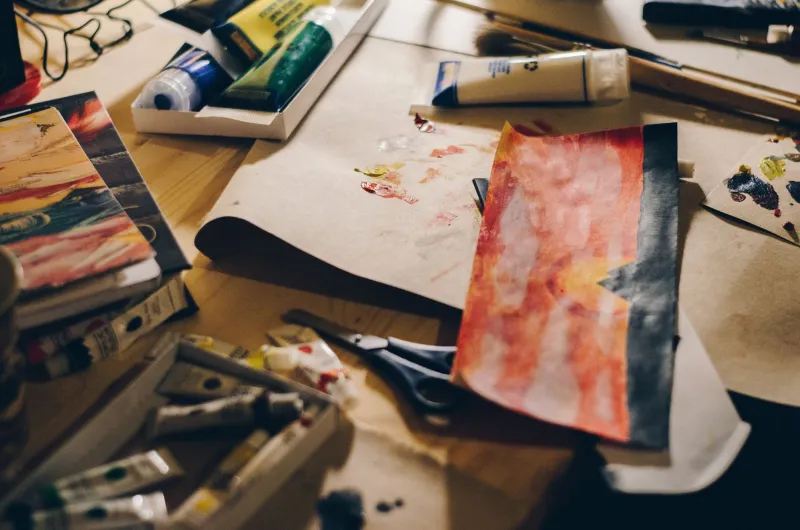
A couple of years ago, I was working on a series of illustrated short stories — personal stuff, rooted in my own experiences growing up between cultures, trying to figure out who I was in a country that didn't always have a box for me. I loved the concept. I believed in it. And I spent almost eight months reworking the same three pieces over and over, convinced that one more revision would finally make them worthy of being shared.
My friend — a photographer who has zero patience for my spiraling — sat down with me one afternoon and asked a question that genuinely stopped me cold: "If these stories are never perfect enough to share, what was the point of writing them?"
I didn't have a good answer.
She wasn't being harsh. She was being honest in the way that only people who care about you can be. And something about hearing it out loud, in her kitchen over bad coffee, made the whole thing click in a way it hadn't when I was alone with my own thoughts at midnight.
The stories weren't for me anymore. They were for whoever needed to read them. And by hoarding them in the name of perfection, I was making a unilateral decision that no one deserved to see them yet. That felt a lot more arrogant than releasing something imperfect.
What the Research Actually Says (And Why It Matters)
Here's something I've thought about a lot: there's a psychological concept called "satisficing" — a mashup of "satisfy" and "suffice" — coined by Nobel Prize-winning economist Herbert Simon. The idea is that sometimes choosing a solution that's good enough leads to better outcomes than endlessly searching for the optimal one. Not because excellence doesn't matter, but because the cost of pursuing it infinitely often outweighs the benefit.
Creative work is not immune to this math.
Every hour I spent obsessing over the third paragraph of an essay was an hour I wasn't writing the next one. Every month I delayed releasing a song was a month I wasn't learning what resonated with people and what didn't. Perfectionism doesn't just stall your current project — it quietly starves everything that comes after it.
The artists I admire most have enormous bodies of work. Not because everything they made was brilliant, but because they kept making things. They treated each release as a data point, a conversation, a step forward — not a verdict on their entire worth as a creator.
The Psychological Shift That Changed Everything
At some point, I had to reframe what "good enough" actually means.
For me, it used to feel like settling. Like waving a white flag. But I've come to think of it differently now: good enough means the work has done what it can do at this stage of my growth. It means I've brought my current best to it. And my current best, released into the world, will teach me things that no amount of private revision ever could.
I also started asking myself a different question before I declare something unfinished. Instead of "Is this perfect?" I ask "Is this honest?" Because honesty — real, specific, vulnerable honesty — is the thing that actually connects. Not polish. Not perfection. The slightly rough edge in a vocal take that sounds like a real human being. The sentence that's a little awkward but says exactly the true thing. Those are the moments people remember.
Perfection, ironically, is often what makes work feel distant.
Practical Ways to Loosen the Grip
If you're a creator who recognizes yourself in any of this, here are a few things that have genuinely helped me:
Set a deadline and treat it like a flight. You wouldn't miss a flight because your carry-on isn't perfectly organized. Give your projects a ship date and honor it the same way.
Define "done" before you start. At the beginning of a project, write down three specific criteria that would make it complete. When you hit those, you're done. Anything after that is bonus, not requirement.
Release something small on purpose. A quick sketch. A voice memo. A rough draft shared with a small audience. Practice the act of letting go in low-stakes situations so it doesn't feel so catastrophic when it counts.
Separate the work from your worth. This one's harder and it takes time. But the piece you're working on is not a referendum on your talent, your value, or your future. It's just a piece. The next one is already waiting.
Find your "good enough" witness. One person who knows your work well enough to tell you honestly when something is ready. Not a hype person. Not a harsh critic. Someone who can see the line between "needs more work" and "you're stalling."
What's Sitting in Your Someday Folder?
I did eventually release those illustrated short stories. Not because they became perfect — they didn't. But because I finally accepted that waiting for perfect was just another way of saying I wasn't brave enough to be seen.
The response wasn't what I'd feared. People connected with the imperfections. Someone messaged me to say that a story felt like it had been written specifically for her. That kind of thing doesn't happen when work stays in a folder.
Your "Someday" folder probably has something in it worth sharing. Not because it's flawless — but because it's yours, and because someone out there is waiting for exactly the thing you've been too scared to send.
Done, with all its rough edges, is still the most generous thing you can offer.